Front Office vs Food & Beverage vs Housekeeping: Which BHM Specialisation Fits You?
Published Date: 23 Sep 2026
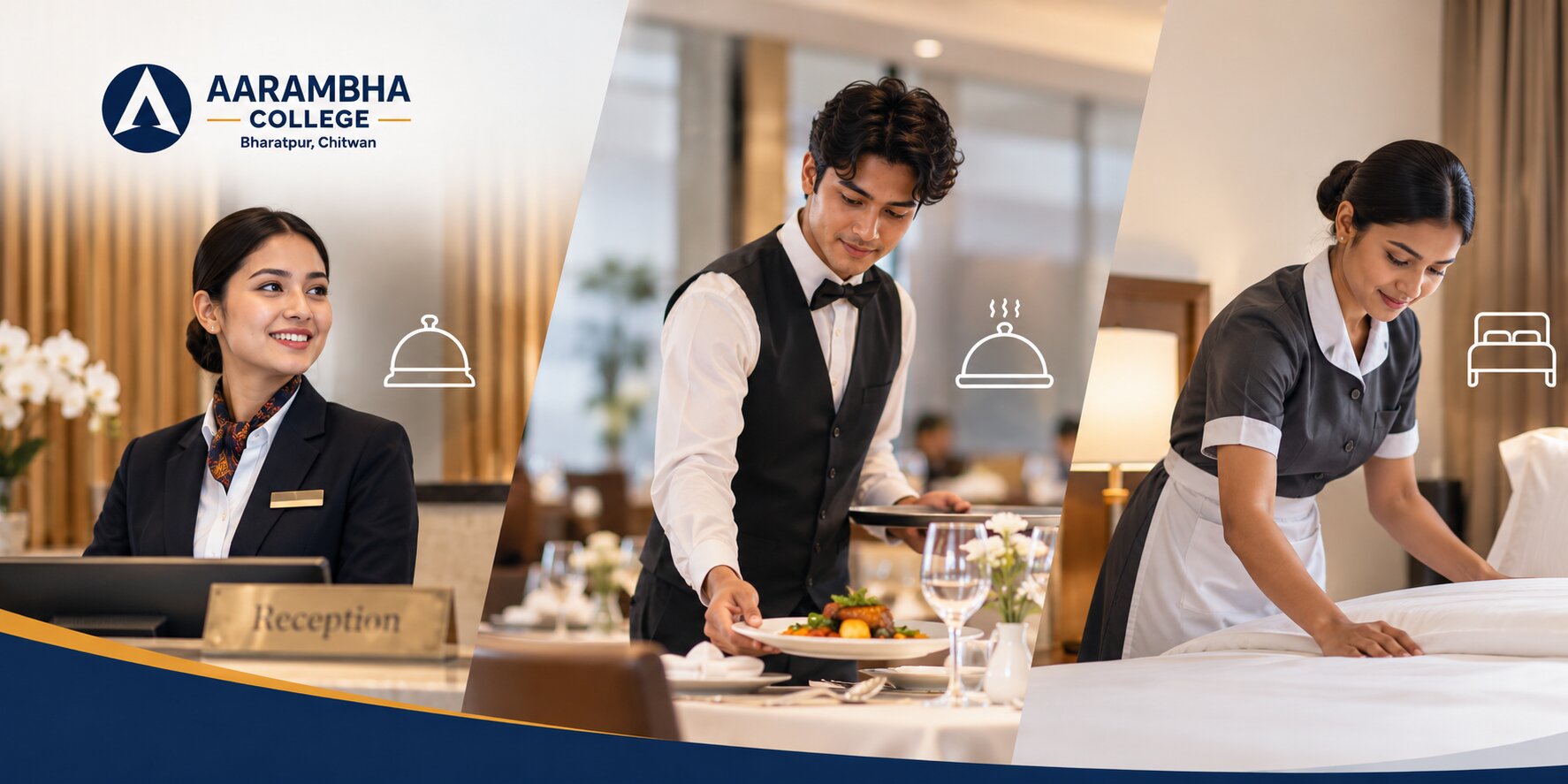
Front Office suits students who enjoy guest communication and problem-solving. Food & Beverage may be a better fit for those who prefer active service and teamwork, while Housekeeping often suits organised, detail-focused students interested in room operations and maintaining service standards.
Although all three contribute to the same hotel experience, the day-to-day work is quite different. Front Office focuses heavily on guest interaction and coordination, F&B centres on service and timing, while Housekeeping is more closely connected with room readiness, presentation and operational standards.
Students often refer to these areas as BHM specialisations, but they are more accurately understood as major hotel operational areas within the degree. Through practical classes, industrial exposure and internships, students get the chance to understand each area more closely and see which one suits their strengths and interests best.
What Is the Difference Between Front Office, Food & Beverage and Housekeeping?
Front Office, Food & Beverage and Housekeeping differ mainly in guest interaction, pace, daily responsibilities and the skills they require. Front Office is the most guest-facing, F&B is usually the most service-driven and fast-paced, while Housekeeping focuses more on room readiness, organisation and consistent standards.
|
Factor |
Front Office |
Food & Beverage |
Housekeeping |
|
Main responsibility |
Managing guest arrival, stay and departure |
Providing food and beverage service |
Preparing and maintaining rooms and hotel areas |
|
Guest interaction |
Very high |
High |
Low to moderate |
|
Work pace |
Variable and sometimes unpredictable |
Fast during service periods |
Structured but time-sensitive |
|
Physical activity |
Moderate |
High |
High |
|
Key skills |
Communication and problem-solving |
Teamwork, service and time management |
Organisation and attention to detail |
|
Best suited to |
Confident communicators |
Active, service-focused students |
Organised, detail-focused students |
The best fit depends on the kind of work you enjoy most. Looking at the BHM course structure and subjects can also help you understand where Front Office, F&B and Housekeeping sit within the wider programme.
What Is Front Office Work Like?
Front Office manages much of the guest journey, from reservations and arrival to the stay and departure. Common responsibilities include check-in and check-out, room allocation, guest enquiries, complaint handling and coordination with departments such as Housekeeping.
Staff may also use property-management or reservation systems to manage bookings, room status and guest information. The O*NET profile for hotel desk clerks includes tasks such as confirming reservations, assigning rooms and maintaining guest records. If a guest arrives before their room is ready, Front Office may also need to coordinate with Housekeeping and keep the guest informed.
Important Front Office skills include:
- clear communication and active listening
- confidence with guests
- problem-solving
- accuracy with bookings and guest details
- basic hotel-system skills
- professional presentation
- ability to stay calm under pressure
Front Office may suit students who enjoy guest interaction, communication and solving problems as they arise.
What Is Food & Beverage Service Work Like?
Food & Beverage Service focuses on the guest dining experience across restaurants, cafés, banquets, room service and other service areas. Common duties include preparing service areas, presenting menus, taking orders, serving food and beverages and coordinating with the kitchen.
The O*NET profile for restaurant service roles includes tasks such as taking orders, serving food and beverages and responding to customer needs. F&B can become especially demanding during busy meal periods or events, when staff must manage timing, priorities and teamwork carefully.
Important F&B skills include:
- guest communication
- teamwork
- service etiquette
- menu and product knowledge
- attention and memory
- time management
- kitchen coordination
- physical stamina
Food and Beverage may suit students who enjoy active work, direct guest service and working closely with a team. It can be a strong fit for those interested in restaurants, banquets and hospitality events.
What Is Housekeeping Work Like?
Housekeeping keeps guest rooms and hotel areas clean, prepared, and ready for use. Its work includes room presentation, linen and amenities, inspections, room-status updates and reporting maintenance issues.
The department also works closely with Front Office to keep room information accurate. If a room looks ready but an amenity is missing or a fixture is damaged, Housekeeping must notice the issue and ensure it is addressed before the next guest arrives.
Important Housekeeping skills include:
- attention to detail
- organisation
- consistency
- time management
- quality checking
- respect for guest privacy
- teamwork
- physical stamina
Housekeeping may suit students who enjoy organised work, clear standards and attention to detail. It can also be a good fit for those interested in accommodation operations with less continuous guest interaction.
What Kind of Guest Interaction Happens in Each Department?
Guest interaction differs more in purpose than simply in frequency. Front Office handles arrival, enquiries, requests and complaints, while F&B interaction centres on dining, orders and service. Housekeeping contact is usually more task-specific, such as responding to room or amenity requests.
This difference matters because each department requires a different communication style. Front Office needs calm problem-solving, F&B depends on attentive service and timing, while Housekeeping requires clear and respectful communication when guest contact occurs.
Which BHM Department Is the Most Difficult?
Each department is demanding differently. Front Office can be challenging because of guest complaints and unexpected situations, F&B becomes intense during busy service periods, and Housekeeping requires physical effort while maintaining consistent room standards.
|
Department |
Common Type of Pressure |
|
Front Office |
Guest complaints, expectations and unexpected situations |
|
Food & Beverage |
Rush periods, timing and multiple service demands |
|
Housekeeping |
Physical workload, room deadlines and consistent standards |
Your own strengths will shape which department feels more difficult. Someone comfortable handling guests may manage Front Office well, while a student who prefers structured tasks may feel more at ease in Housekeeping.
Which Department Fits Your Work Style Best?
Your work style can point you towards the department you may enjoy most, especially once you compare how each role actually feels during a shift.
- Front Office may suit you if you enjoy talking with people, solving problems, handling changing situations and staying composed when guests need help.
- Food & Beverage may suit you if you like active work, teamwork, fast service and restaurant or event environments.
- Housekeeping may suit you if you prefer organised tasks, notice small details and enjoy maintaining consistent room and presentation standards.
These preferences can change once you gain practical experience. A student who feels unsure about guest interaction, for example, may become much more confident after practical classes or an internship.
Which Department Offers Better Career Growth?
Career growth depends more on your experience, performance and the opportunities available within a hotel than on the department you choose.
Typical progression may include:
- Front Office: Front Desk Associate, Supervisor, Assistant Manager, Front Office Manager
- Food & Beverage: Service Associate, Supervisor, Assistant Manager, F&B Manager
- Housekeeping: Room Attendant, Floor Supervisor, Assistant Executive Housekeeper, Executive Housekeeper
Job titles and promotion paths vary between hotels, but each department can lead to supervisory and management roles. You can also explore the wider career options after Hotel Management to understand how experience can shape your career after BHM.
Can You Change Hotel Departments Later?
You can move from Front Office, F&B or Housekeeping to another hotel department later in your career, depending on the role, your experience and the skills required. Communication, teamwork, guest service and knowledge of hotel operations can transfer across departments.
Switching may still require additional training, system knowledge or practical experience. Your first department can help you build a foundation while you discover which area of hotel operations suits you best.
Which Department Should You Choose for Your BHM Internship?
Choose the department that matches the type of work you want to experience most. Your internship is a practical way to test whether Front Office, F&B or Housekeeping suits you beyond the classroom. The current TU BHM curriculum also includes industrial exposure as part of the programme.
Before deciding, ask yourself:
- Which practical area do I enjoy most?
- How much guest interaction do I want?
- Do I prefer structured tasks or changing situations?
- Am I more interested in restaurant service or room operations?
- Which type of pressure do I handle best?
- What skills do I want to develop during the internship?
It also helps to prepare for the kinds of questions hotels may ask during placement interviews. These BHM internship interview questions cover Front Office, F&B and Housekeeping topics students may need to revise.
How Do Front Office, F&B and Housekeeping Work Together?
Front Office, F&B and Housekeeping work together by sharing information and responding to different parts of the guest experience. A smooth stay often depends on these departments coordinating quickly and accurately.
For example:
- Housekeeping prepares the room and updates its status when it is ready.
- Front Office checks the room status, assigns the room and welcomes the guest.
- F&B may serve the guest in a restaurant, banquet area or through room service.
- If the guest requests extra towels, reports a room issue or orders food, Front Office may coordinate with Housekeeping or F&B to get it resolved.
- Each department updates or communicates the information needed so the guest does not have to repeat the same request.
This coordination is why learning about more than one department is useful in BHM. Even if you later prefer one area, understanding how the other departments work can help you communicate better, solve problems faster and see how the hotel operates as a whole.
Which BHM Specialisation Fits You Best?
Your choice should reflect the type of work you enjoy, the environment in which you perform well and the skills you want to develop. Choosing a department because it sounds more prestigious is less useful than looking at the actual work and whether it matches your strengths.
You also do not need to decide your entire hospitality career before starting BHM. Practical classes, internships and workplace exposure can change your interests as you gain a better understanding of hotel operations.
If you are still deciding between broader hotel operations and a more kitchen-focused path, comparing BHM vs Culinary Arts in Nepal can help you understand the difference between the two study directions.
Considering BHM After +2?
If Front Office, F&B or Housekeeping sounds like an area you would like to explore further, BHM can help you build a broader understanding of hotel operations before focusing more deeply on the work that suits you. It also gives you the chance to develop practical skills and see how different departments work together in a real hospitality setting.
At Aarambha College in Bharatpur, Chitwan, students can explore a TU-affiliated BHM programme in Chitwan that combines academic learning with practical exposure to different areas of hospitality. Reviewing the course structure, practical components and current admission details can help you decide whether the programme matches your interests and plans.
FAQs
Is Front Office a good specialisation in BHM?
Front Office suits students who enjoy communication, guest service and problem-solving. It is a major operational area within BHM rather than a separate degree.
Which is better, Front Office or Food & Beverage?
Front Office is better suited to students who enjoy guest communication and coordination, while F&B suits those who prefer active service, restaurants and teamwork.
Is Housekeeping a good career after BHM?
Housekeeping can lead to roles in room operations, supervision and accommodation management. Career growth depends on experience, performance and available opportunities.
Which hotel department is best for introverts?
Housekeeping may suit students who prefer less continuous guest interaction. Introverted students can still do well in Front Office or F&B with strong communication skills.
Is Housekeeping only about cleaning in a hotel?
Housekeeping covers more than cleaning. It also involves room preparation, inspections, linen and amenities, room-status updates and maintaining accommodation standards.
Do you need computer skills for Front Office?
Basic computer skills are useful in Front Office because staff may work with reservation and property-management systems for bookings, room status and guest information.
Is Food & Beverage only about restaurant service?
Food & Beverage covers more than restaurant service. Depending on the hotel, it can include banquets, room service, cafés, beverages and other dining or event-service operations.