BBA vs BITM in Nepal: Which One Fits the 2026 Economy?
Published Date: 31 Jul 2026
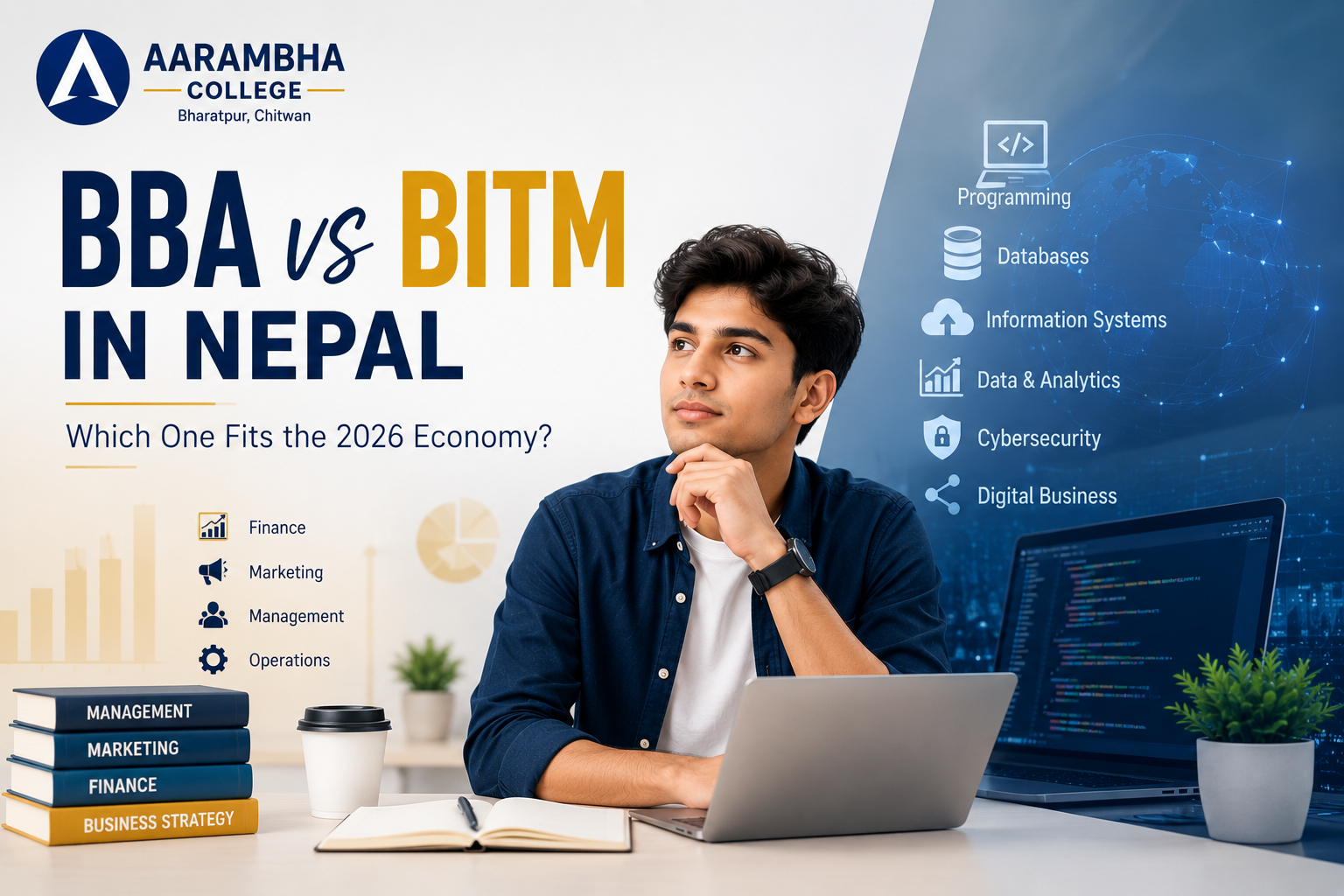
For Nepal's 2026 economy, BITM aligns more directly with digital growth, while BBA remains relevant across the wider business economy. BITM suits students interested in technology-enabled roles, while BBA offers broader pathways in finance, management and operations.
Nepal’s banks, payment providers and e-commerce platforms are expanding their digital services. This makes business and technology skills increasingly relevant, while organisations still need professionals who can manage finance, strategy and operations. The right choice depends on whether you prefer solving business problems or combining them with programming and digital systems.
This guide compares the TU curricula, eligibility requirements, CMAT process, career opportunities and salary factors. It also explains the BIM and BITM naming difference and helps you decide which degree matches your interests and Nepal's economy.
BBA vs BITM in Nepal: What Is the Main Difference?
The main difference between BBA and BITM is the type of problems students learn to solve. BBA focuses on managing organisations, while BITM connects business processes with technology.
BBA students learn how organisations manage finance, marketing, people, operations and strategy. BITM students study core business subjects alongside programming, databases, networking and information systems.
|
Comparison area |
BBA |
BITM |
|
Main focus |
Business administration and management |
Business management and information technology |
|
Business preparation |
Finance, marketing, HR, operations, sales and strategy |
Management foundations applied to technology-enabled organisations |
|
Technology preparation |
Computer applications, databases, information systems and e-commerce |
Programming, databases, networking, software, analytics and cloud systems |
|
Typical work style |
Commercial analysis, planning, communication and people management |
Technical problem-solving, systems analysis and digital operations |
|
Common career direction |
Banking, finance, marketing, HR, sales and operations |
IT support, business analysis, software, digital operations and fintech |
|
Best suited to |
Students mainly interested in business functions |
Students interested in both business and technology |
BBA is not separate from technology. Its TU curriculum includes computer applications, databases, business information systems and e-commerce.
BITM is also not a purely technical degree. It combines its larger IT component with business subjects such as accounting, economics, marketing, finance and management.
Is BITM the Same as BIM in Nepal?
Under Tribhuvan University, BITM is the current programme title. BIM refers to the earlier Bachelor of Information Management title and curriculum.
TU’s Bachelor of Information Technology Management curriculum applies from the 2025 admission batch onwards. However, some college websites and older academic materials still use BIM.
Students applying in 2026 should confirm three details with their chosen college:
- The official programme title
- The admission batch followed
- The exact TU curriculum being taught
This clarification matters because older BIM and current BITM curricula do not use the same subject and credit distribution.
How Do the BBA and BITM Course Structures Compare?
The current TU BBA programme requires 120 credit hours, while BITM requires 126 credit hours. Both run for four years across eight semesters.
BBA places greater emphasis on management, allied business subjects and specialisation. BITM assigns more than half its credits to information technology and computing.
|
Course-structure area |
BBA |
BITM |
|
Programme duration |
Four years |
Four years |
|
Number of semesters |
Eight |
Eight |
|
Total credit hours |
120 |
126 |
|
Management component |
84 credits in management and allied courses |
30 credits in management courses |
|
Technology component |
12 credits in computer-related courses |
66 credits in IT and computing courses |
|
Analytical and support component |
Included within management and allied courses |
18 credits |
|
Academic choice |
18 credits of business specialisation |
6 credits of IT electives |
|
Project work |
3-credit summer project |
3-credit project |
|
Internship |
3 credits |
3 credits |
|
Semester load |
15 credits in each semester |
18 credits in semesters 4 and 6; 15 credits in other semesters |
These figures come from TU's published BBA and BITM curricular structures. The categories are not directly equivalent, but they clearly show where each programme places its academic emphasis. BBA follows its current curriculum effective from the 2021 academic batch, while BITM uses the structure effective from the 2025 admission batch.
What Are the Eligibility Requirements for BBA and BITM?
Under TU’s 2026 admission rules, BBA and BITM have the same minimum eligibility. Applicants may come from any recognised +2, PCL or equivalent discipline.
Applicants need a minimum CGPA of 1.8, with grade D in theory and grade C in practical examinations for each subject. Students with second-division marks also qualify.
Students awaiting Grade 11 and 12 results may apply. However, they must submit their pass certificates when completing admission.
Passing the Central Management Admission Test (CMAT) is compulsory for both programmes. The test contains 100 objective questions covering:
- Verbal ability
- Quantitative ability
- Logical reasoning
- General awareness
Applicants must score at least 40 per cent to qualify for the interview. Shortlisted candidates are then interviewed and considered for admission.
Meeting the minimum requirements does not mean both degrees suit every student equally. BBA requires comfort with accounting, mathematics and analytical assignments.
BITM requires regular practice in programming, databases and computer systems. Previous computer study is not compulsory, but students should be willing to learn coding from the first semester.
What Career Opportunities Do BBA and BITM Offer in Nepal?
BBA and BITM can both support careers in banking, consulting, e-commerce and business operations. BBA prepares students mainly for commercial functions, while BITM connects organisational requirements with technology.
BBA develops financial interpretation, communication and people management skills. BITM combines a smaller management component with programming, databases, information systems and other technical subjects.
What Jobs Can BBA Graduates Pursue?
BBA graduates may begin in trainee, assistant or junior roles: management trainee, relationship officer, credit assistant, finance assistant, marketing assistant, HR coordinator, operations executive. Students exploring these options can also review the most common private-sector jobs after BBA in Nepal.
In banking, they may support customer service, credit processing or branch operations. They may also pursue digital marketing, sales coordination, brand support, HR, administration and operations roles across companies, startups and NGOs.
Entrepreneurship is another possible path. Some graduates pursue consulting, retail or service businesses, but success also requires capital, planning and operational experience.
What Jobs Can BITM Graduates Pursue?
BITM graduates may pursue roles such as IT support specialist, business analyst, junior developer, QA coordinator, database assistant or systems administrator.
They may work in digital banking, e-commerce, information systems or technology-enabled operations. Students comparing BITM with a more programming-focused degree can also read BITM vs BCA in Nepal.
However, BITM does not guarantee a technical job. Employers may still expect coding projects, internships or a portfolio showing practical ability.
Which Careers Are Open to Both Graduates?
Graduates of both programmes may compete for roles in banking, e-commerce, consulting and project coordination. BBA graduates usually align more closely with commercial operations, while BITM graduates align with information systems and technology-enabled operations.
Banks may recruit BBA graduates for customer-facing, credit and operational roles, and BITM graduates for payment systems, data support and digital operations. E-commerce companies may recruit BBA graduates for vendor management and sales, and BITM graduates for platform and analytics support.
Employers also consider communication, spreadsheet skills, internship quality and practical work. Financial models and presentations can strengthen a BBA application, while relevant projects and code samples can strengthen a BITM application.
What Are the Salary Expectations After BBA and BITM in Nepal?
Some technical roles may offer higher entry-level pay, but neither BBA nor BITM has one standard starting salary. Earnings depend on the job, practical ability, employer, location and demonstrated skills.
BBA graduates commonly begin in trainee, assistant, sales, banking or junior executive roles. Students looking for a more detailed role-by-role discussion can review this guide to BBA salary in Nepal. Some positions also include commissions or performance incentives, particularly in sales, insurance and business development.
BITM graduates may enter IT support, software testing, junior development, data reporting or digital operations. Applicants with strong coding, database, systems or analytical skills may qualify for better-paying technical positions.
However, BITM does not automatically lead to a higher salary. A weak technical portfolio can limit opportunities, while a BBA graduate with strong finance, sales or digital marketing skills may secure an equally competitive role.
Salary growth usually depends on:
- The specific job and level of responsibility
- Practical, commercial and technical ability
- Employer size and industry
- Location
- Internship and project experience
- Communication skills
- Certifications and portfolio evidence
- Individual performance and career progression
Students should review current vacancies for their preferred roles instead of relying on one general “BBA salary” or “BITM salary” figure. Higher earnings usually depend more on role-relevant skills and experience than on the degree title alone.
Which Degree Fits Nepal’s 2026 Economy?
BITM aligns more directly with Nepal’s digital growth, while BBA remains relevant across the wider business economy. BITM offers stronger preparation for technology-enabled work, while BBA provides broader pathways in finance, marketing, sales and operations.
Nepal Rastra Bank recorded approximately 78.9 million mobile-banking transactions during the month ending mid-May 2026. QR-based payments reached 59.3 million transactions, while digital wallets recorded 49.9 million.
These numbers were higher than in the same month of 2025, showing the increasing use of digital payment infrastructure. This growth makes technology, data and digital-process skills increasingly relevant across banking, payments and e-commerce.
These trends strengthen the relevance of BITM for digital banking, fintech, e-commerce, business analysis, information systems and digital operations. However, graduates still need practical technical skills to compete for specialised roles.
BBA remains important because every digital or traditional business still needs finance, marketing, sales, human resources and operational management. These functions support organisations across banking, retail, hospitality, education and professional services.
The practical answer is:
- BITM fits Nepal’s fintech, e-commerce and technology-enabled growth more directly.
- BBA fits a broader range of established business and commercial functions.
BITM may provide stronger differentiation when employers need both technical and business understanding. BBA may offer greater flexibility for students who want wider business career options.
Common Mistakes When Choosing BBA or BITM
Students sometimes choose BBA or BITM based on salary claims, current trends or advice from friends and family. However, a degree that appears attractive today may not suit you if its subjects, learning style and career direction do not match your genuine interests.
Before applying, understand the practical demands of each programme and consider the type of work you want to pursue after graduation. Avoid these common mistakes:
- Choosing based only on salary: BITM is not always the higher-paying option, and BBA does not automatically lead to a well-paid banking or finance career. Earnings depend on your role, skills, experience, employer and performance.
- Assuming BITM guarantees an IT career: Completing BITM alone may not be enough for software, data or fintech roles. Employers often expect coding projects, internships, certifications and evidence of practical technical ability.
- Thinking BBA is easy or ordinary: BBA requires consistent effort in accounting, finance, analysis, communication and business problem-solving. Students who focus only on passing examinations may struggle to compete.
- Ignoring college quality: The programme title is only one part of the decision. Faculty experience, laboratories, teaching methods, internship support and fee transparency can significantly affect your learning experience.
- Following others without reviewing the course: A programme that suits a friend or relative may not suit you. Compare the subjects, costs, facilities and career paths before deciding.
- Relying only on the university syllabus: The syllabus provides academic knowledge, but employers also expect practical ability. BBA students should strengthen their communication, Excel and commercial skills, while BITM students should develop coding, systems knowledge and technical portfolios.
The degree provides the foundation, but your practical experience, skills and commitment will shape the opportunities you can pursue after graduation.
Decision Checklist Before Admission
Before choosing BBA or BITM, review the programme, college and complete cost carefully. This can help you avoid academic, financial and career-related problems later.
- Confirm the programme and syllabus: Check whether the college offers BBA or the current BITM programme. Confirm the admission batch, TU curriculum and whether older materials still use BIM.
- Review the admission process: Check the latest TU eligibility requirements, CMAT format, passing requirement, interview process and final selection procedure.
- Assess the college facilities: Review the faculty, classrooms, library and academic support. For BITM, also inspect the computer laboratories, internet reliability, software access and frequency of practical classes.
- Check the complete cost: Request a written breakdown of admission, semester, examination, laboratory, library and additional fees. Ask about scholarships, instalment options and refund policies.
- Review internship and career support: Ask about internship partners, career counselling, placement support, industry exposure and recent graduate outcomes. Request specific examples rather than relying only on general claims.
- Consider your personal situation: Compare the family budget, travel time, class schedule, learning support and whether the programme matches your interests and career plans.
- Visit the college before enrolling: Tour the classrooms and laboratories, meet faculty members and speak with current students. A four-year decision should not be based only on advertisements, phone calls or social media.
Taking time to verify these details can help you compare colleges more realistically and avoid choosing based only on advertising or assumptions. Once the programme, costs and learning environment are clear, you can focus on which degree better matches your interests and long-term career direction.
Which Degree Should You Choose?
Choose according to the work that genuinely interests you, not trends, salary claims or peer pressure. In Nepal’s 2026 economy, the better fit depends on which part of the economy you want to work in.
Choose BBA If You Prefer
BBA suits students interested in banking, finance, marketing, sales, human resources and business operations. These functions remain essential across Nepal’s financial institutions, service companies, retailers and growing businesses.
Choose BITM If You Prefer
BITM suits students interested in fintech, digital payments, e-commerce, information systems, data and technology-enabled operations. It aligns more directly with Nepal’s expanding digital economy, but students need strong technical skills and practical projects to compete.
The central question is whether you prefer managing commercial and organisational functions or combining business knowledge with technology. Neither degree guarantees success, so choose the path you can remain committed to for four years.
Final Thoughts
After comparing the curricula, eligibility, career paths, salary factors and Nepal’s 2026 economy, neither BBA nor BITM is the automatic winner. BBA offers broader commercial flexibility, while BITM provides a more focused pathway into technology-enabled business.
The stronger choice is the degree that matches your abilities and the work you want to pursue after graduation. In either programme, internships, practical projects, communication and consistent skill development will shape your career outcomes.
For students interested in combining management with programming, data and digital systems, Aarambha College offers the current TU BITM programme in Chitwan. Explore the curriculum, learning facilities and admission requirements, or speak with the admissions team to decide whether BITM is the right fit for your future.
FAQs
Which Is Better, BBA or BITM in Nepal?
Neither degree is universally better. BBA suits students interested in finance, marketing, management and operations, while BITM suits those interested in business, programming and digital systems.
Is BITM the Same as BIM in Nepal?
BITM is the current Tribhuvan University programme title, while BIM refers to the earlier Bachelor of Information Management curriculum. Students applying in 2026 should confirm which syllabus their college follows.
Can Management Students Study BITM?
Yes. Students from any recognised +2, PCL or equivalent discipline may apply if they meet TU’s eligibility requirements and pass the CMAT.
Does BITM Require Coding?
Yes. BITM includes C, Java and Python, along with web programming, databases and software engineering. Previous computer study is not compulsory, but students must practise coding regularly.
Is BITM Harder Than BBA?
BITM involves more programming and technical assignments, while BBA requires accounting, finance, mathematics and business analysis. The difficulty depends on the subjects and learning style you find more comfortable.
Does BITM Offer a Higher Salary Than BBA?
Not automatically. Some technical roles may offer stronger starting opportunities, but salary depends on the job, employer, practical skills, experience and portfolio rather than the degree title alone.
Can BITM Graduates Pursue an MBA?
Yes. BITM graduates may apply for MBA and related postgraduate programmes, subject to the eligibility requirements of the university and programme they choose.