BBS vs BBM in Nepal: Which Degree Is Better for You?
Published Date: 05 Jun 2026
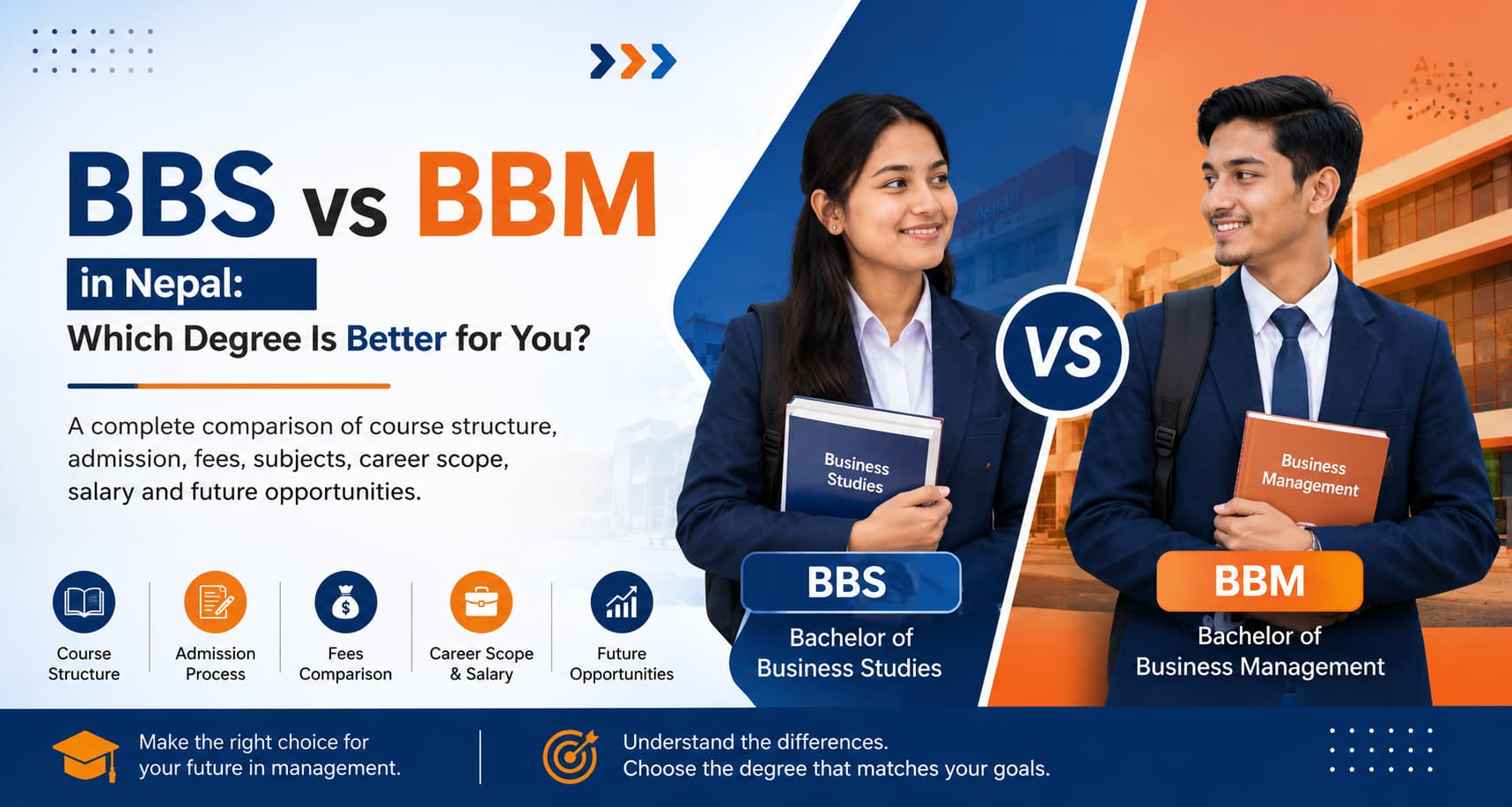
BBS vs BBM in Nepal: Which Degree Is Better for You?
Choosing between BBS and BBM in Nepal can be confusing for students who have just completed +2 and want to study management. Both degrees are offered under Tribhuvan University, and both can lead to careers in banking, finance, marketing, HR, operations, and business management. However, the course structure, learning style, admission process, and career focus are different.
BBS is often a good choice for students who want an affordable and broad business degree with flexibility for higher studies, government jobs, CA, or MBA. BBM is more suitable for students who prefer a structured, management-focused programme with subjects related to leadership, operations, business strategy, and organisational management.
This guide compares BBS and BBM in Nepal based on course structure, eligibility, admission process, fees, subjects, career scope, salary, and future opportunities so you can choose the degree that fits your goals.
BBS vs BBM in Nepal: Quick Comparison.
Before choosing between BBS and BBM, it helps to understand the main differences clearly. Both are four-year management degrees under Tribhuvan University, but they differ in learning style, fees, admission process, and career focus.
|
Factor |
BBS |
BBM |
|
Full Form |
Bachelor of Business Studies |
Bachelor of Business Management |
|
Duration |
4 years |
4 years |
|
Exam System |
Annual system |
Semester system |
|
Entrance Exam |
Usually not required |
CMAT required |
|
Fee Range |
More affordable |
Usually higher than BBS |
|
Main Focus |
Broad business, accounting, and management |
Management, leadership, and operations |
|
Best For |
Students want flexibility and affordability |
Students wanting structured management learning |
|
Career Scope |
Banking, accounting, finance, admin, government jobs |
Banking, HR, marketing, operations, corporate roles |
|
Fresher Salary |
Around NPR 15,000 to NPR 25,000 per month |
Around NPR 18,000 to NPR 35,000 per month |
BBS is usually better for students who want an affordable and flexible management degree, while BBM is more suitable for students who prefer a structured, career-focused business programme.
What is BBS?
Bachelor of Business Studies (BBS) is one of the most widely offered management degrees in Nepal. It is a four-year annual programme under TU's Faculty of Management, covering 120 credit hours across business, economics, accounting, finance, marketing, and management.
BBS is structured on a year-wise annual exam system, and students sit for board exams at the end of each academic year. In the final year, students can choose a concentration in accounting, finance, marketing, or management.
Over 700 colleges across Nepal offer BBS, making it one of the most accessible management degrees in the country. No entrance exam is required for admission, though students must have completed +2 with at least 45% marks and studied Mathematics or Economics as a full paper.
Key features of BBS
- Annual exam system (one board exam per year)
- No CMAT entrance exam required
- Available in most districts across Nepal
- Low cost, especially at government campuses
- Strong foundation for CA, CMA, MBA, and MBS preparation
- Recognised for government job vacancies, including Nepal Rastra Bank, Public Service Commission, and civil service roles
What Is BBM?
Bachelor of Business Management (BBM) is a more specialised management degree under TU's Faculty of Management, structured on an eight-semester system over four years. BBM is designed specifically for students who want to build careers in management, leadership, operations, HR, business development, and corporate roles.
Unlike BBS, BBM requires students to appear for the CMAT (Central Management Admission Test) conducted by TU. Admission is based on a merit list that weighs 60% CMAT score, 30% +2 marks, and 10% interview performance.
Currently, 62 colleges in Nepal offer BBM, with 41 of them in Kathmandu. The programme is considered more industry-focused, with an emphasis on practical management skills, entrepreneurship, leadership, and business strategy alongside academic subjects.
Key features of BBM
- Semester system (exams every 6 months, twice per year)
- CMAT entrance exam required
- Available in select colleges, mostly in urban areas
- More management-focused curriculum
- Better preparation for corporate and leadership roles
- CMAT score also qualifies you for BBA, BHM, BIM, and BTTM admissions
BBS vs BBM: Course Structure and Subjects
Both BBS and BBM cover business fundamentals, but their structure and focus are different. BBS is broader and includes subjects such as business English, economics, accounting, business statistics, business mathematics, marketing, finance, management, organisational behaviour, and business law. In the final year, students can specialise in areas such as accounting, finance, marketing, or management.
BBM is more structured and management-focused from the beginning. It includes subjects such as principles of management, business communication, organisational behaviour, financial management, human resource management, operations management, marketing management, entrepreneurship, business research, and business strategy. Since BBM follows a semester system with regular internal assessments, students are evaluated more consistently, while BBS offers more flexibility through its annual exam system.
Admission Requirements for BBS and BBM in Nepal
The admission process for BBS and BBM is one of the major differences between the two degrees. BBS admission is usually more direct, while BBM requires students to appear for the CMAT entrance exam under TU’s Faculty of Management.
BBS Admission Requirements
For BBS, students can usually apply directly to colleges after completing +2 from any stream. Most colleges require students to have at least 45% marks in +2, along with English as a full paper. Some colleges may also require students to have studied Mathematics or Economics as a full paper.
Since BBS does not usually require an entrance exam, admission is often based on the student’s +2 marks and the college’s own admission process.
BBM Admission Requirements
BBM admission is more competitive because students must appear for the CMAT entrance exam. To apply, students should have passed +2 with at least a D+ grade in all subjects and a CGPA of 1.8 or above, or second division marks.
The final selection is usually based on CMAT score, +2 marks, and interview performance. CMAT tests verbal ability, quantitative ability, logical reasoning, and general awareness, and it is also used for other TU management programmes such as BBA, BHM, BIM, and BTTM. Since requirements may change, students should always check the latest TU or college admission notice before applying.
BBS vs BBM: Fees in Nepal
Cost is one of the biggest differences between BBS and BBM in Nepal. While both are four-year management degrees under Tribhuvan University, BBS is generally much more affordable, especially at government campuses. BBM usually costs more because it follows a semester-based structure and is often offered with a more management-focused academic setup.
|
Programme |
Government Campus |
Private College |
|
BBS |
NPR 35,000 – 45,000 (full course) |
NPR 1.5 – 4 Lakhs |
|
BBM |
NPR 2,70,000 – 3,50,000 |
NPR 3.5 – 9 Lakhs |
BBS at a government campus is one of the most affordable higher education options in Nepal. If budget is a significant concern for your family, BBS is the practical choice, especially at a TU constituent campus.
BBM costs considerably more, even at government institutions. However, the structured curriculum and management-specific skills development are seen as justifying the higher investment for students who can afford it.
BBS vs BBM: Career Scope in Nepal
Both degrees open doors to the private sector, government sector, NGO/INGO, and entrepreneurship roles. However, the types of roles and the paths differ.
BBS Career Scope
BBS graduates can apply for roles in banking, accounting, finance, marketing, HR, administration, government service, NGOs, and education. Key advantages of BBS for career development include:
- Strong eligibility for government and civil service exams (Lok Sewa Aayog, NRB)
- Good foundation for CA and CMA professional exams
- Wide network of alumni across all industries due to the programme's reach
- Suitable for students who want to pursue an MBA or MBS after graduation
BBM Career Scope
BBM graduates are seen as more management-ready for corporate and private sector roles, particularly in operations, HR, business development, sales management, marketing, and team leadership. Key strengths include:
- Structured management training that aligns well with corporate hiring needs
- Stronger preparation for leadership and mid-management roles
- Practical and analytical skills relevant to operations and business planning
- Good foundation for MBA and MBM postgraduate programmes
To understand the full salary growth journey for BBM graduates, from fresher level to management roles, you can refer to the detailed BBM salary guide for Nepal.
BBS vs BBM: Salary in Nepal
Starting salary for both degrees is broadly similar, though BBM graduates in management-focused roles often start slightly higher in the private sector.
|
Career Stage |
BBS Graduate |
BBM Graduate |
|
Fresher (0–1 year) |
NPR 15,000 – 25,000 |
NPR 18,000 – 35,000 |
|
Junior Executive (1–3 years) |
NPR 25,000 – 45,000 |
NPR 25,000 – 50,000 |
|
Mid-Level Officer (3–5 years) |
NPR 35,000 – 60,000 |
NPR 40,000 – 70,000 |
|
Senior / Manager (5+ years) |
NPR 50,000 – 1,00,000+ |
NPR 60,000 – 1,50,000+ |
It is important to note that after three to five years of experience, the gap between BBS and BBM salaries narrows considerably. What matters more at the mid and senior level is your skills, performance, and the company you work for, not the degree name. Both BBS and BBM graduates can reach the same salary levels with consistent professional development.
BBS vs BBM: Which Is Better for Government Jobs?
BBS has a clear advantage for government jobs in Nepal. The degree is widely recognised for positions under the Public Service Commission (Lok Sewa Aayog), Nepal Rastra Bank, and other government and semi-government organisations.
Many BBS graduates pursue civil service examinations in financial and administrative streams, where their accounting and economics background is directly relevant. BBS is also a strong platform for students preparing for CA or CMA alongside their degree.
BBM graduates can also apply for government jobs, but BBS is the more traditional and widely recognised qualification for civil service pathways in Nepal
BBS vs BBM: Which Is Better for the Private Sector?
In the private sector, BBM has a slight edge, particularly for management trainees, operations, HR, business development, and corporate leadership roles. The management-focused curriculum and structured semester system align well with what private companies look for in fresh graduates.
That said, BBS graduates are also hired extensively in private banking, insurance, marketing, sales, and finance roles. The difference is not dramatic at the entry level. Over time, the deciding factor becomes skills, experience, and continuous learning, not the degree itself.
If you are specifically targeting a private sector career in banking, digital marketing, HR, or business development, you may also want to explore what private sector jobs look like after a business degree to understand what employers typically look for.
Who Should Choose BBS?
BBS is the better choice if:
- You want an affordable management degree without an entrance exam
- You are interested in government jobs or civil service after graduation
- You plan to pursue CA, CMA, MBA, or MBS and need a broad business foundation
- You are from outside Kathmandu and want access to a college close to home
- Your family has a limited budget for higher education
- You prefer studying at your own pace with year-end exams rather than semester pressure
Who Should Choose BBM?
BBM is the better choice if:
- You want a structured, management-focused degree that builds leadership and operational skills
- You are targeting corporate and private sector roles in management, HR, operations, or business development
- You are confident in your CMAT preparation and can qualify through the entrance process
- You are comfortable with a higher fee investment for a more industry-aligned curriculum
- You want a degree that prepares you well for an MBA or MBM afterwards
- You prefer the semester system with regular assessments rather than annual year-end exams
Can You Switch from BBS to BBM or Vice Versa?
It is not straightforward to transfer between BBS and BBM mid-programme, as both have different structures, credit systems, and exam formats. If you are still at the +2 stage and deciding between them, it is better to make a careful choice from the start rather than trying to switch later.
If you are unsure, appearing for the CMAT exam gives you options. A good CMAT score qualifies you for BBA, BBM, BHM, BIM, and BTTM, giving you more flexibility to choose based on your score, interest, and available college options.
Final Thoughts
Both BBS and BBM are strong management degrees, but they suit different types of students. BBS is a better choice for students who want an affordable, flexible, and widely available degree with a scope in banking, accounting, government jobs, higher studies, and professional certifications.
BBM is more suitable for students who prefer a structured semester-based programme with a stronger focus on management, leadership, operations, and private sector careers. Your final choice should depend on your budget, learning style, career goal, and long-term plans, not just what your friends are choosing.
FAQs
What is the difference between BBS and BBM in Nepal?
BBS (Bachelor of Business Studies) is an annual programme with no entrance exam, available at 700+ colleges across Nepal at a low cost. BBM (Bachelor of Business Management) is a semester-based, management-focused programme that requires CMAT and is offered at around 62 colleges. BBM has a stronger management focus; BBS offers broader accessibility and government job relevance.
Which is better for government jobs: BBS or BBM?
BBS is better suited for government jobs in Nepal. It is widely recognised for Public Service Commission (Lok Sewa Aayog) vacancies and civil service roles in finance and administration. BBM graduates can also apply, but BBS has a stronger tradition in this path.
Which is better for private sector jobs: BBS or BBM?
BBM has a slight advantage for private sector management and corporate roles due to its structured curriculum. However, BBS graduates are also widely hired across banking, marketing, sales, finance, and HR roles in the private sector.
Does BBM require a CMAT exam in Nepal?
Yes, the CMAT (Central Management Admission Test) is mandatory for BBM admission under Tribhuvan University. Students must score at least 40% in CMAT and meet the merit list criteria based on CMAT score, +2 marks, and interview.
Is BBS cheaper than BBM?
Yes, BBS is significantly more affordable. At a government campus, BBS costs as little as NPR 35,000–45,000 for the full four-year course. BBM at government campuses costs NPR 2.7–3.5 Lakhs, and private college fees can go up to NPR 9 Lakhs.
What is the salary after BBS in Nepal?
Fresh BBS graduates typically earn NPR 15,000–25,000 per month in entry-level roles. With two to five years of experience, salaries can rise to NPR 30,000–60,000 or more, depending on the role and organisation.
What is the salary after BBM in Nepal?
Fresh BBM graduates typically earn NPR 18,000–35,000 per month. With experience, mid-level professionals can earn NPR 40,000–70,000, and senior managers can earn NPR 70,000–1,50,000 or more. For a detailed breakdown, see the BBM salary guide for Nepal.
Can BBS graduates pursue an MBA in Nepal?
Yes, BBS graduates can pursue an MBA or MBS after completing their degree, provided they meet the eligibility criteria of the respective university or programme.
How many colleges offer BBM in Nepal?
Currently, 62 colleges offer BBM under Tribhuvan University in Nepal, with 41 of them located in Kathmandu. BBS, by contrast, is available at over 700 colleges nationwide.