BITM vs BCA in Nepal: Which IT Degree Has Better Career Value?
Published Date: 19 May 2026
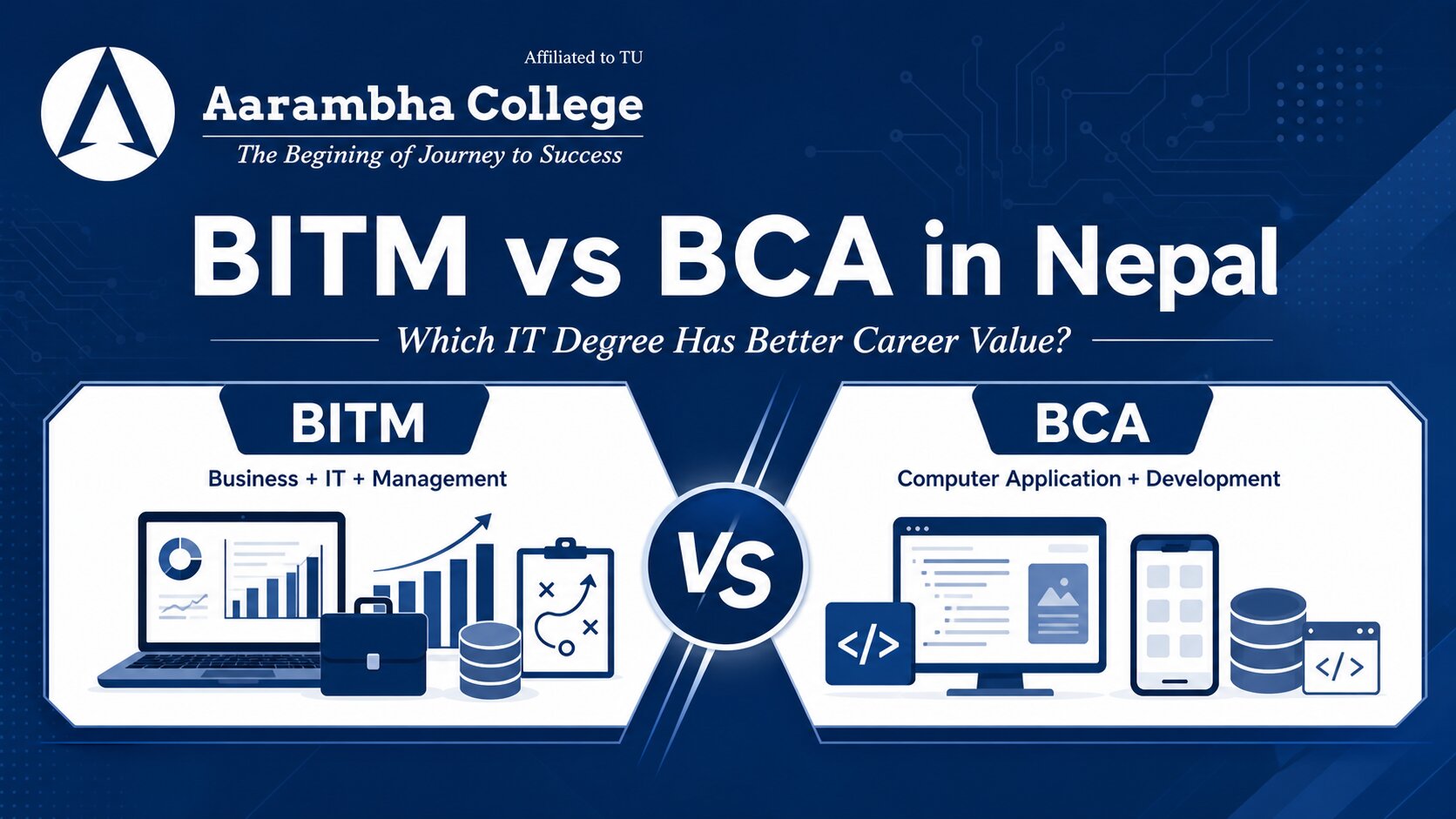
BITM vs BCA in Nepal: Which IT Degree Has Better Career Value?
Choosing between a BITM and a BCA degree in Nepal is an important decision for students planning a career in technology, software development, business IT, startups, or the digital sector. Both degrees offer good career opportunities, but they focus on different areas of the IT industry and suit different types of students.
BITM is best for students interested in combining information technology with business, management, decision-making, and organisational problem-solving. In contrast, BCA is more focused on programming, software development, databases, and practical computer application skills. Your choice should depend on whether you are more interested in management and business IT or coding and technical development.
This guide will help Nepali students understand the key differences between BITM and BCA, including syllabus structure, course focus, fees, career scope, salary expectations, opportunities for further study, and which degree offers better value for different career goals and learning styles.
What is BITM?
BITM(Bachelor of Information Technology Management) is a four-year undergraduate degree that combines information technology with business and management studies. It is designed for students who want to understand both technical IT concepts and how technology is used in modern organisations.
The course covers areas like computing, information systems, database management, software development, business fundamentals, entrepreneurship, and organisational problem-solving. In simple terms, BITM is a good choice for students who want a balanced degree in IT, business, and management.
What is BCA?
BCA (Bachelor of Computer Applications) is a four-year undergraduate degree focused on computer applications, programming, and software development. It is designed for students who want to build technical knowledge and practical IT skills for the modern technology industry.
The course covers areas like coding, database management, web technologies, networking, system design, application development, and technical problem-solving. In simple terms, BCA is a good choice for students who want a software-development-oriented IT degree with a stronger focus on coding and technical skills.
BITM vs BCA in Nepal: Main Difference
The main difference between BITM and BCA in Nepal is that BITM combines IT with business and management, while BCA focuses more on computer applications, programming, and software development. BITM is better for students interested in business-tech roles, whereas BCA is better for students who want to build a career in coding, software, web, or app development.
BITM vs BCA Comparison Table
|
Basis |
BITM in Nepal |
BCA in Nepal |
|
Full Form |
Bachelor of Information Technology Management |
Bachelor of Computer Application |
|
Main Focus |
IT + management + business systems |
Computer applications + programming + software development |
|
Faculty |
Faculty of Management, TU |
Faculty of Humanities and Social Sciences, TU |
|
Duration |
4 years |
4 years |
|
Academic System |
8 semesters |
8 semesters |
|
Best For |
Students who want IT with management and business knowledge |
Students who want a coding and software development focus |
|
Course Nature |
Balanced between technical and managerial subjects |
More focused on computer applications and technical skills |
|
Practical Exposure |
Projects, case studies, group work, assignments, internship |
Programming, software projects, database work, application development |
|
Entrance Requirement |
CMAT for TU Faculty of Management programs |
BCA entrance process under TU FOHSS |
|
Career Direction |
IT officer, business analyst, system analyst, project coordinator, IT manager, digital business roles |
Software developer, programmer, database administrator, system analyst, web developer |
|
Higher Studies |
MIT, MBA, MBS, MIS, IT management, business analytics |
MCA, MIT, MBA, computer science, software engineering-related fields |
|
Best Choice If |
You want both technology and management |
You want stronger coding and application development |
How Does the Course Structure Differ in BITM and BCA?
BITM and BCA are both four-year undergraduate degrees, but their course focus is different. BITM combines information technology with business and management, making it suitable for students who want IT knowledge along with management, communication, and business exposure.
BCA is offered under the Faculty of Humanities and Social Sciences at Tribhuvan University and focuses more on computer applications. It is a four-year, eight-semester course designed to produce skilled computer application users and developers.
The BCA subjects include areas such as computer fundamentals, programming in C, digital logic, mathematics, Java, UX/UI design, database systems, web technology, software engineering, networking, artificial intelligence, cybersecurity, cloud computing, internship, and project work.
Best for:
- BITM: Students who want IT with management and business exposure
- BCA: Students who want a stronger software and application development route
Differences in Learning Style and Practical Focus
BITM offers a balanced learning style that combines technology with business and management. Students learn IT subjects along with communication, leadership, project handling, teamwork, decision-making, and organisational problem-solving. This makes BITM suitable for students who want to understand how technology is used in real companies, banks, startups, and digital businesses.
BCA is more focused on programming, software tools, databases, and application development. While BCA is suitable for students who want a coding-focused route, BITM gives a wider career direction by connecting technical knowledge with business and management skills. This makes BITM a strong choice for students interested in IT companies, corporate offices, banking technology, digital business, and technology-based management roles.
Differences in Subjects and Syllabus
BITM covers a wider mix of IT and management-related subjects, making it suitable for students who want technical knowledge along with business understanding. Students may study areas like programming, database management, information systems, web technology, networking, software design, business communication, accounting and finance basics, organisational behaviour, project management, e-commerce, business strategy, internship, and project work.
BCA focuses more on computer applications and software-related subjects, such as programming, Java, digital logic, database systems, web technology, software engineering, networking, system analysis, mobile application development, and project work. Overall, BITM gives students a broader academic foundation because it connects IT with business, management, communication, and real organisational needs, making it a strong choice for IT management, business analysis, digital business, project coordination, banking technology, and corporate IT roles.
Eligibility and Admission in Nepal
For BITM, students must complete twelve years of schooling or an equivalent level from a recognised board or institution. Since BITM is offered under the TU Faculty of Management, students also need to meet the required academic criteria and appear in CMAT, which tests areas such as verbal ability, quantitative ability, logical reasoning, and general awareness.
For BCA, students from different academic backgrounds can also apply if they have completed PCL, +2, or equivalent level with the required minimum marks or grade criteria. However, the admission process is different because BCA falls under a separate faculty.
Overall, BITM is a strong option for students who want to enter the IT field through a management-focused route. It is especially suitable for students who want to study technology while also building business, communication, leadership, and organisational skills.
BITM vs BCA Fees in Nepal
The fee for BITM and BCA in Nepal can vary depending on the college, location, university affiliation, facilities, and scholarships. BITM fees range from Rs. 1.5 lakh to Rs. 2.5 lakh in public colleges and around Rs. 4 lakh to Rs. 8.8 lakh in private colleges, while BCA fees range from Rs. 3 lakh to Rs. 12 lakh in private colleges.
BITM offers strong value for students seeking exposure to both IT and management. Since the course integrates technology, business, project work, communication, and career flexibility, students should not only compare fees but also consider practical learning, career support, internship opportunities, and overall college facilities.
Practical Decision-Making Factors:
- If you want IT with management and business exposure, choose BITM
- If you want a more programming-focused IT route, choose BCA
- If budget is a major factor, compare the total 4-year cost and career support offered by the college.
Career Scope and Job Opportunities
BITM is highly valuable for students who want to build a career in both IT and business-related fields. It is suitable for roles in IT management, business analysis, information systems, banking technology, project coordination, digital business, e-commerce, and corporate IT because it builds knowledge in technology, management, communication, and organisational decision-making.
BCA offers stronger opportunities for students who want to focus primarily on technical IT careers, especially in roles such as software developer, web developer, app developer, programmer, database administrator, systems analyst, and technical support officer. While BCA is more coding-focused, BITM offers students a broader career path by integrating IT with business and management skills.
Higher Study Opportunities After BITM and BCA
Both BITM and BCA support higher studies in Nepal and abroad, but the best pathway depends on your future career goal. BITM is more suitable for students who want to grow in IT management, digital business, business analytics, project management, data analytics, or technology-based leadership roles. After BITM, students can pursue higher studies such as MIT, MBA, MBS, MIS, Business Analytics, IT Management, Project Management, and Data Analytics.
BCA is more suitable for students who want deeper technical knowledge in software, programming, and computer applications. After BCA, students can pursue higher studies such as MCA, MIT, Software Engineering, Data Science, Cybersecurity, Artificial Intelligence, and Cloud Computing. In simple terms, BITM gives students a wider pathway in both IT and management, while BCA is more focused on technical and programming-related higher studies.
Skill Development Comparison
BITM helps students develop both technical and management skills. Students learn about IT systems, databases, software concepts, communication, business decision-making, project coordination, leadership, research, and entrepreneurship. This makes BITM useful for students who want to understand how technology is used in real organisations and businesses.
BCA focuses more on technical and application-based skills. Students develop skills in programming, software development, web design, database handling, system analysis, and technical problem-solving. This makes BCA suitable for students who mainly want to become developers, programmers, or technical IT professionals.
BITM vs BCA: Which Course Has Better Job Scope in Nepal?
Both BITM and BCA offer good career opportunities in Nepal, but the scope of work and career paths for each course differ. BITM is better for managing and applying technology in businesses, while BCA is better for students who want to build software and work deeply with coding and technical development.
BITM is more suitable for students who want careers that combine technology, business, and management. Graduates can work in business analysis, banking technology, project coordination, digital business, e-commerce, information systems, and corporate IT management. The degree is especially valuable in organisations where communication, planning, management, and technology work together.
BCA is better suited for students who want more technical, programming-focused careers. BCA graduates have stronger opportunities in software development, web and app development, database management, IT support, networking, and other coding-related roles.
How to Decide Between BITM and BCA in Nepal?
The right choice depends on your interest, career plan, learning style, and the type of IT future you want.
1. Do I Want IT with Management or Pure Application Development?
If you want to study IT along with business, management, leadership, communication, and organisational problem-solving, BITM is the better fit.
If you want to focus mainly on programming, software development, web development, databases, and technical IT work, BCA is the better fit.
2. Am I More Interested in Coding or Business Technology?
If you enjoy coding, building apps, solving programming problems, and learning technical tools, BCA may suit you better.
If you enjoy technology but also want to understand business operations, management, project coordination, and how companies use IT systems, BITM may suit you better.
3. What Kind of Job Do I Imagine After Graduation?
If you imagine yourself as a software developer, web developer, app developer, programmer, database administrator, or technical IT professional, BCA may align better with your goals.
If you imagine yourself as an IT officer, business analyst, systems analyst, IT project coordinator, MIS officer, digital business executive, or future IT manager, BITM may align more closely with your goals.
4. Do I Want a Flexible Career Path?
BITM offers flexibility by connecting technology with business. This can help students move into IT, management, banking technology, digital marketing technology, e-commerce, project handling, or entrepreneurship.
BCA also offers flexibility within the technical field. Students can move into software development, web development, app development, data, cybersecurity, and remote or freelance work if they build strong practical skills.
5. What Is My Budget?
Before choosing between BITM and BCA, compare the total 4-year cost, not just the admission fee. Check semester fees, exam fees, lab fees, project costs, scholarship options, and any additional training costs.
You must also consider the value the college offers. A slightly higher fee can be worth it if the college provides good lab facilities, practical learning, internship support, mentorship, and career guidance.
Advantages of Studying BITM or BCA in Nepal
|
Comparison Area |
Advantages of BITM |
Advantages of BCA |
|
Learning Focus |
Combines IT, management, and business |
Stronger focus on computer applications and programming |
|
Career Fit |
Good for IT management, business analysis, MIS, and project coordination |
Good for software development, web development, programming, and database roles |
|
Skill Strength |
Builds technical + managerial + communication skills |
Builds technical + coding + software development skills |
|
Higher Studies |
Good for MIT, MBA, MIS, IT management, business analytics |
Good for MCA, MIT, software engineering, data science, and computer-related fields |
|
Practical Use |
Useful in corporate IT, banks, digital businesses, and startups |
Useful in software companies, IT firms, freelancing, app and web development |
|
Best For |
Students who want technology with management |
Students who want deeper technical and coding exposure |
|
Long-Term Value |
Strong for IT leadership and business technology roles |
Strong for technical IT and development careers |
|
Career Flexibility |
Can move between IT, business, management, and digital roles |
Can grow into technical specialisation and development roles |
FAQs
Is BITM better than BCA in Nepal?
BITM is better for students who want both IT and management knowledge. BCA is more focused on coding and software development.
Is BITM a good course in Nepal?
Yes, BITM is a good course for students who want to build a career in IT, business, digital companies, banks, and the corporate sector.
What is the career scope of BITM in Nepal?
BITM graduates can work as IT officers, business analysts, system analysts, MIS officers, project coordinators, and digital business executives.
Can BITM students work in the IT field?
Yes, BITM students can work in the IT field because they study programming, databases, information systems, web technology, and IT management.
Can BITM students become software developers?
Yes, BITM students can become software developers if they build strong coding skills, work on projects, and create a good portfolio.
Which is better for management and IT, BITM or BCA?
BITM is better for students who want both management and IT. It gives students a wider career path than a purely technical course.
Is BITM good for future career growth?
Yes, BITM is good for future growth because it prepares students for both technical and managerial roles.
Can BITM students do an MBA?
Yes, BITM students can do an MBA if they meet the university’s eligibility requirements.
Which course should I choose after +2, BITM or BCA?
Choose BITM if you want IT with management, business, and career flexibility. Choose BCA if you mainly want to focus on coding and software development.
Which is more affordable?
BITM is generally more affordable than BCA in Nepal, especially in public or TU-affiliated colleges. The total fee can vary depending on the college, facilities, and scholarship options.